
Protective Services
Protective Services encompass a number of departments and services including, fire, policing and emergency management programs. The Township is serviced by one volunteer fire department with three stations location in Embro, Thamesford and Uniondale. Policing service to Township residents is provided by the Oxford Detachment of the Ontario Provincial Police. The Township’s Emergency Management program is managed by the Township’s Emergency Management Coordinator and operated in accordance with the provincially legislated Emergency Management Act.
Green Courtesy Light for Ontario Firefighters
Pull over for green flashing lights! These are volunteer emergency responders enroute to help someone in need. View the public education video regarding green flashing lights.
The carbon monoxide regulation (O. Reg. 194/14) has now become law in Ontario and comes into force as of October 15, 2014. O. Reg. 194/14 amends the Fire Code and introduces mandatory installation, replacement, testing and maintenance requirements for CO alarms in residential dwellings. It is the owner’s/landlord’s responsibility under the Ontario Fire Code to ensure both installation and maintenance of carbon monoxide alarms.
As of January 1st, 2026 updates have been made to the Ontario Fire Code. For more information visit https://www.ontario.ca/page/carbon-monoxide-safety
Click here to watch a heartfelt and informative video that tells the story of Hawkins-Gignac Foundations mission and what every homeowner in Ontario needs to know about this new law.
There are several companies in the area that provide Fire Extinguisher Services. Click on any of the website links below for more information.
Every home in Ontario must have a working smoke alarm on every storey and outside all sleeping areas - it's the law! Failure to comply with the Fire Code smoke alarm requirements could result in a ticket of $360.00, or a fine of up to $50,000 for individuals and $100,000 for Corporations.
Landlords
It is the responsibility of landlords to ensure their rental properties comply with the law. We strongly encourage landlords to use our smoke alarm checklists to keep a record of all maintenance work done on smoke alarms.
Tenants
If you are a tenant of a rental property and do not have the required number of smoke alarms, contact your landlord immediately. It is against the law for tenants to remove the batteries or tamper with the alarm in any way.
When installing smoke alarms, refer to the manufacturer’s instructions for information about correct placement. Test your smoke alarms every month using the test button. Replace smoke alarm batteries at least once a year, and whenever the low-battery warning chirps. Smoke alarms don't last forever. Replace smoke alarms with new ones if they are more than ten years old. Steam from the shower or cooking in the oven, stove or toaster can cause smoke alarms to activate. Do not remove the battery. Instead, try moving the alarm to a different location, or purchase a smoke alarm with a hush feature that will temporarily silence the alarm.
Homeowners
It is the responsibility of homeowners to install and maintain smoke alarms on every storey of their home and outside sleeping areas.
Choosing the Correct Alarm
Be sure the smoke alarms you buy carry the label of an independent testing laboratory such as ULC or CSA.
Several types of alarms are available. Some run on batteries, others on household electric current. Some detect smoke using an "ionization" sensor, others use a "photoelectric" detection system. All approved smoke alarms, regardless of the type, will offer adequate protection provided they are installed and maintained properly.
A photoelectric alarm is recommended for areas that are prone to nuisance alarms such as kitchens and outside bathrooms.
How Many Should You Buy?
Every home should have a smoke alarm outside each sleeping area and on every level of the home, including the basement. On floors without bedrooms, alarms should be installed in or near living areas, such as dens, living rooms, or family rooms.
Be sure everyone sleeping in your home can hear your smoke alarms. If any residents are hearing-impaired or sleep with bedroom door closed, install additional alarms inside sleeping areas as well. There are special smoke alarms for the hearing impaired that flash a light in addition to sounding an audible alarm.
For extra protection, fire departments suggest installing alarms in dining rooms, furnace rooms, utility rooms and hallways. Smoke alarms are not recommended for kitchens, bathrooms or garages - where cooking fumes, steam or exhaust fumes could set off nuisance alarms.
Installing Alarms
For the reason that smoke rises, mount alarms high on a wall or on the ceiling, depending on the manufacturer’s instructions.
In stairways with no doors at the top or bottom, position smoke alarms anywhere in the path of smoke moving up the stairs. But always position smoke alarms at the bottom of closed stairways, such as those leading to the basement, because dead air trapped near the door at the top of a stairway could prevent smoke from reaching an alarm located at the top.
Do not install a smoke alarm too close to a window, door, or forced-air register where drafts could interfere with the alarm's operation. For the best results, follow the printed instructions that come with the smoke alarm.
Most battery-powered smoke alarms and alarms that plug into wall outlets can be installed using only a drill and a screwdriver by following the manufacturer's instructions. Plug-in alarms must have restraining devices so they cannot be unplugged by accident. Alarms can also be hard-wired into a building's electrical system. Hard-wired alarms should be installed by a qualified electrician. Never connect a smoke alarm to a circuit that can be turned off by a wall switch.
Replacing Alarms
Smoke alarms purchased over the last few years will have an expiry date stamped into the back of the alarm. Manufacturers recommend replacing any smoke alarm that is over 10 years old. While the smoke alarm may still look okay and may test when the button is pressed, they can still deteriorate over time. The interior workings that allow the alarm to "smell" the smoke may become coated with grease, dust, cobwebs and dirt and may reduce its ability to detect smoke.
How to Obtain a Smoke Alarm
The Ontario Fire Code mandates that there must be a working smoke alarm on each storey of the home. It is the expectation as the property owner that you install smoke alarms as required. If you live in a rental unit, ask the property owner to install one or more working smoke alarms. Property owners are obligated by law to ensure there is at least one working smoke alarm in every rental unit. If the owner does not respond or comply, contact the Fire Prevention Division and we will contact the property owner to make certain the rental unit is in compliance with the law.
Maintaining a Smoke Alarm
Only a functioning smoke alarm can protect you. This is why you should never disable an alarm. This includes borrowing its battery for another use or ripping it off of the ceiling.
Testing and Maintaining
- Follow the manufacturer's instructions, and test all your smoke alarms monthly.
- You should also install new batteries at least once a year. A good reminder is when you change your clocks in the spring or fall: change your clock, change your battery.
- Clean your smoke alarms using a vacuum cleaner without removing the alarm's cover and never paint over a smoke alarm.
- Smoke alarms do not last forever. Replace any smoke alarm that is more than 10 years old.
Plan and Practice
- Make sure everyone is familiar with the sound of the alarm.
- Plan escape routes. Know at least two ways out of each room. Agree on a meeting place outside your home where all residents will gather after they escape. Practice your escape plan at least twice a year.
- Remove obstructions from doors and windows needed for escape.
- Make sure everyone in the household can unlock doors and windows quickly, even in the dark. Windows or doors with security bars should be equipped with quick-release devices and everyone in the household should know how to use them.
- When an alarm sounds, leave immediately. Go directly to your outside meeting place and call the fire department.
- Once you're out, stay out. Never return to a burning building.
Created by the Office of the Fire Marshal “No Time to Spare” is a popular educational video of a fatal fire re-creation to emphasize the importance of preventing fires, maintaining working smoke alarms, practising home fire escape plans and installing residential sprinklers. Click here to view the video.
Message from Fire Department about Light Bulb Safety
"Below is a picture of a CFL light bulb from my bathroom. I turned it on the other day and then smelled smoke after a few minutes. Four inch flames were spewing out of the side of the ballast like a blow torch! I immediately turned off the lights. But I'm sure it would have caused a fire if I was not right there. Imagine if the kids had left the lights on as usual when they were not in the room. I took the bulb to the Fire Department to report the incident. The Fireman wasn't at all surprised and said that it was not an uncommon occurrence. Apparently, sometimes when the bulb burns out there is a chance that the ballast can start a fire. He told me that the Fire Marshall had issued reports about the dangers of these bulbs.
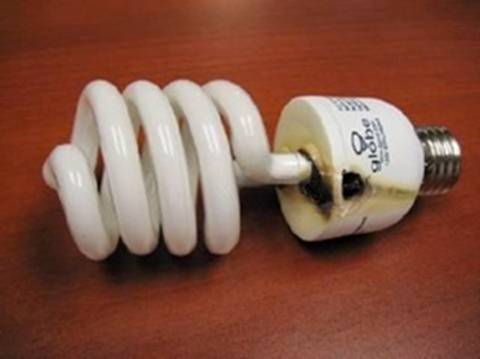 Upon doing some Internet research, it seems that bulbs made by“Globe” in China seem to have the lion’s share of problems. Lots of fires have been blamed on misuse of CFL bulbs, like using them in recessed lighting, pot lights, dimmers or in track lighting. Mine was installed in a normal light socket.
I will be removing all the Globe bulbs from my house. CFL bulbs are a great energy saver but make sure you buy a name brand like Sylvania, Phillips or GE and not the ones from China."
CAUTION: Be careful when recycling batteries, especially 9 volt batteries found in many of our smoke detectors today! Smoke detector batteries should be replaced regularly and therefore they may still be carrying a charge when you remove them, causing a potential fire hazard if stored incorrectly.
Recycling and disposing of these batteries is simple. Place a piece of electrical tape over the positive and negative terminals preventing them from making contact which will assist with the elimination of a potential hazard of stored batteries. Click here to watch an informative video.
REMEMBER: Safety starts at home.
For more information please contact the Township of Zorra Fire Chief at 519-485-2490 ext. 7240.
On October 9, 2019, Health Canada issued a notice to interested parties to warn them about the dangers and risk mitigation measures for certain containers of pourable alcohol-based fuels and certain portable firepots that use pourable fuels. View the full notice here.
Oxford County has created an information sheet regarding abandoned wells in southwestern Ontario. This sheet contains details on how to identify abandoned wells, the potential hazards and risks they pose to public health and the environment, and contact information for the MNRF Abandoned Works Program. Oxford County has planned to mail out the information sheet to rural residents who have an active or abandoned well near or on their property. To view the locations of these wells, follow this link. Click here to view the information sheet.
Public Safety Message from the Ontario Fire Marshal - August 30, 2019
TORONTO — Jon Pegg, Ontario’s Fire Marshal, is alerting Ontarians to the significant fire safety risks associated with ethanol-fueled appliances, commonly known as tabletop fire features or pots. A fire hazard, called flame-jetting, occurs as fuel vapours are ignited when refueling these appliances that are not fully extinguished, and a flame is not readily visible.
“Ontario has recorded multiple fatalities and serious injuries related to the refueling of these ethanol-fueled appliances this year,” noted Pegg. “Since 2016, the Office of the Fire Marshal and Emergency Management (OFMEM) has conducted eleven fire investigations that involved the use of these appliances.”
Ethanol-fueled appliances are currently sold across the province and throughout the rest of Canada. The OFMEM recommends people protect themselves when using these appliances and help prevent flame-jetting by following these tips:
- Make sure any flames in an ethanol-fueled appliance are fully out and that it is cold to the touch before refueling
- Only refuel when no one is near the appliance
- When refueling, use a fuel container that has a flame arrestor.
People are encouraged to contact their local fire service if they have questions about other fire safety measures that can be taken to protect themselves and their family.